San Diego Couple Builds Their Home Using Prefab Construction to Avoid Standard Costs
Location: Carmel Valley Road, Del Mar Terrace
Description: 4,000 square feet in two-story configuration on 60-foot-wide lot
Manufacturer: Guerdon Enterprises, Boise, Idaho
General contractor: Lusk Custom Design & Construction, San Diego
Architect: Joseph Remick, Orinda
Cost:
Modules: $646,000
Transportation and installation: $21,000
Other costs: $350,000
Total: $1,017,000
Source: Lusk Custom Design & Construction
When Cliff Hanna and his wife, Lana Le, bought a dream lot overlooking Torrey Pines State Reserve, they hired an architect to design a dream home to match.
The trouble was that the price tag came out at $2 million.
“The cost was way too much to build,” Hanna said. “We couldn’t afford it.”
So the couple turned to Hanna’s father, Charles Hanna, a civil engineer who recommended a cheaper construction method: modular housing.
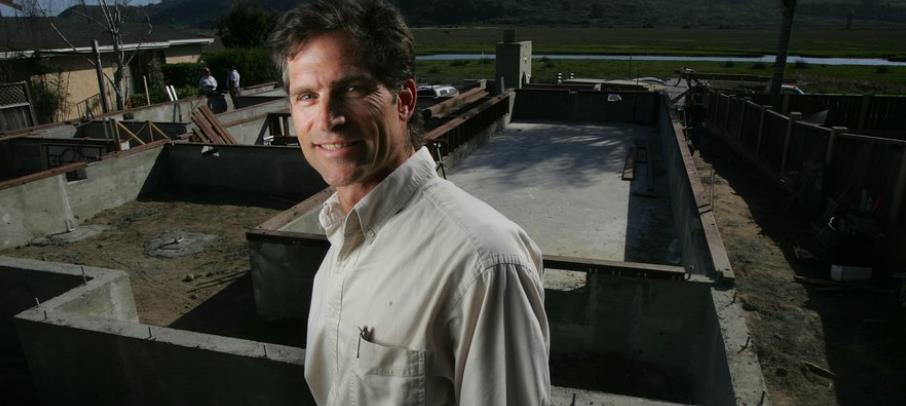
This week, the results of that detour from standard, site-building construction will arrive. A caravan of flatbed trucks will deliver four modules built in Boise, Idaho. A crane will place them on a concrete foundation, constructed over the past six months, in a matter of hours.
Then, over the next three months, Lusk Custom Design & Construction will complete a connecting structure and install the appliances, fixtures and flooring. The Hannas hope to move in by early summer.
Total projected cost: $1,017,000. Time from start to finish: nine months.
Compare that with the 12 months or more it takes to build a comparable custom home and it’s easy to see why modular might be the wave of the future as the U.S. home-building industry shakes off the recession.
“The overall housing market has seen a decline,” said Tony Gacek, executive director of the National Association of Home Builders’ Building Systems Councils. “But in this decline, I think builders are learning more and more that they need to find very cost-effective, streamlined ways to produce quality homes for consumers.”
Hanna’s house is not like the Sears kit-built homes popular in the early 20th century: Order a cottage from the catalog and it’ll be shipped in pieces for assembly. Nor is it a triple-wide mobile home that can fly apart in a windstorm or burn to a crisp in a wildfire.
This house, contains 25 percent more lumber, making it strong enough to withstand the 750-mile journey from Idaho and the stresses that occur when the modules are lifted into place.
From what the designers, manufacturers and builders say, modular homes are built of the same raw materials used in traditional on-site projects. The cabinetry, appliances, fixtures, flooring, paint and all other components are no different from what’s found in any tract home.
And in the Hannas’ case, there will be some energy-saving, environmentally sustainable features, such as a solar-power system to generate electricity and bamboo flooring, that builders are touting.
Proponents of modular housing argue that building in a factory reduces waste; protects against rain, wind and other inclement weather; and offers better quality control through constant in-house company inspection as well as the usual licensed inspectors who enforce California’s stringent building code.
Hanna learned all this as he researched modular housing and visited the manufacturer. He acknowledged that the original, architect-designed plan might have been more attractive, but he’s content with the modular alternative, which will still include decks, patios and a 20-foot atrium bridging the modules. The price tag, of course, was the best part of this experiment.
“We’re all looking for affordable housing, and this is one way to do it,” Hanna said.
There are downsides to modular construction. The imagination of the architect is somewhat limited by what a factory can churn out, though Hanna’s architect, Joseph Remick of Orinda, said he was able to custom-design the second-floor modules within the limitations of what can be transported from the factory.
Another difference is that slight changes can be made on site when building from scratch; construction drawings often differ from conditions on the ground, and last-minute adjustments are necessary. But modular units and their foundations must be precisely aligned. For the Hanna house, the modules must fit exactly onto 13 sets of 28-inch-long bolts embedded in concrete. There is only one-sixteenth of an inch in wiggle room.
Even with all the advances in technology, only 3 percent of single-family homes built in 2008 — 23,000 out of 819,000 — were classified as modular, according to the U.S. census. That’s down from a high of 46,000 in 2002.
But it’s no secret that most homes built these days contain modular components — from building trusses to kitchen cabinets and window frames. Every builders show attracts hundreds of such manufacturers.
Dan Horne, spokesman for Guerdon, said his company began with mobile homes in the early 1950s and branched out into modular construction in recent years.
“We wanted to participate in more mainstream and diversified types of modular products,” Horne said.
He added that with Guerdon’s capacity of producing 800 homes per year, business is down about 50 percent from the peak and is dominated by multifamily military housing orders; 10 percent to 15 percent comes from custom orders, such as the Hannas’. The company employs about 130 people.
Steve Lusk, who has spent most of his career constructing standard, site-built homes, said he hopes the Hanna house will offer a new line of business for him and other builders.
“It’s not the first time someone has done modular housing in San Diego,” he said. “But a custom modular, we can’t find anyone to own up to it.”
Lusk said the costs should appeal to clients who wish to go modular.
“You’re not going to find many custom builders that will sell a custom home for under $200 per square foot,” he said. “They’re going to be between $200 and $300, depending on how nice they are.”
The Hannas’ home will come in at about $175 per square foot, not counting the “soft costs” for planning, inspection and site work.
“I’m convinced it’s a better way to build,” Lusk said. “It’s quicker, requires less supervision.”
Kelly Broughton, director of the city of San Diego’s Development Services Department, said he and his staff are familiar with modular construction and agree that it offers many advantages.
“Some countries have adopted it a lot more than the U.S.,” but it might gain popularity as more examples become available, Broughton said. He also said modular fits the city’s “green” and “clean technology” agenda.
As for Hanna, he said he believes in modular as a way to go, but his wife, a physician, is waiting to see what the finished product feels like before she is convinced that the result is as satisfactory as a traditionally built home.
Many a marriage goes sour when couples embark on a major remodeling or custom-home project, so speeding up the process through modular construction at least reduces the tension time.
“We’re doing OK, but it’s definitely not easy,” Hanna said.
The typical differences between plan and construction cannot be tolerated, since the modules have to sit exactly on the foundation as the plan specifies; 13 sets of 28-inch-long bolts embedded in concrete have to fit into the modules with no more than a 1⁄16th inch tolerance allowed.
Reprinted from San Diego Union Tribune
Contact your local Prefab Construction Expert: USModular, Inc. for more information
info@usmodularinc.com
888-987-6638
http://patch.com/california/oceanside-camppendleton/san-diego-couples-goes-prefab